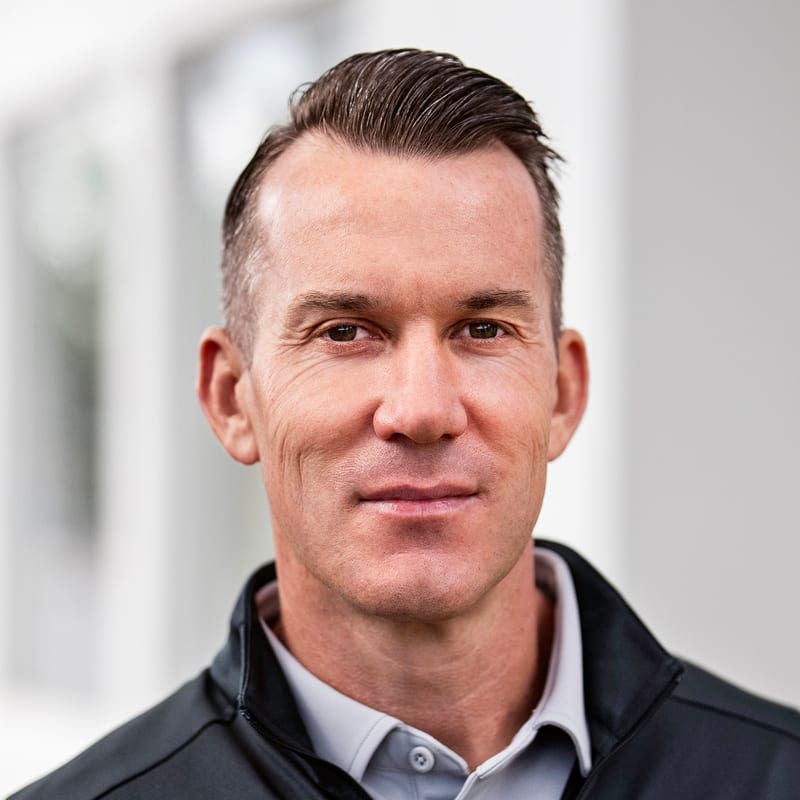
 Jesse Hopps
About
Is your organization evolving fast enough to comfortably achieve your growth targets?
It's the question I ask enterprise leaders in charge of commercial transformation, every day. Underneath it is the one I've worked on for years: why do people who understand what they should do, and even agree they should do it, still not do it? I didn't go looking for that question. It turned up in the gap between a workshop that scored well and a phone call two weeks later.
How I got here
- Age 9London, Ontario
We didn't have a lot of extra money growing up. I had to put myself through university, so I worked full time and went to school part time. I'd been working since I was nine anyway — selling flowers door to door, and I was good at it.
My goal was Ivey, the business school at Western, and the place you go if you want a firm like McKinsey to hire you. I didn't get pre-accepted out of high school, where a ninety-five average wasn't enough, so I started in philosophy and applied again after two years. I didn't get in that time either. Philosophy taught me to pull a difficult challenge apart before answering it, and that turned out to be the most useful thing I know how to do.
My grandfather was brilliant and hard on everyone around him. He used to tell me I had potential, then tell me potential mostly gets squandered and ends up a source of disappointment. He kept a line on his screensaver. I was a kid, and it stuck.
Your thoughts shape your actions. Your actions shape your habits. Your habits shape your character. Your character shapes your destiny.
His screensaver - First jobFriday afternoons
Five years at a research firm in London, selling to executives while I finished school. The CEO used to pull me into his office on Fridays, open a bottle of wine, and ask a twenty-year-old salesperson what was broken about his company.
I'd tear into him. He loved it. Twenty years later I built a whole method on that one habit: ask the people doing the work what's in the way, then shut up and listen.
- At 24Vancouver
I quit, moved west, and started Demand Metric. I had been going to run an events company; that fell apart, so I built a research and tools business instead. One line from my old boss ran the whole thing: build once, sell many times.
It worked. 6,589 companies across 108 countries, tens of thousands of subscriptions, a library of playbooks for commercial leaders who didn't want to pay a consulting firm to do their thinking for them. I did very well out of it.
And it wasn't enough.
- BrokeThe expensive part
I ran a software company alongside it and lost millions. Undercapitalized, my own fault. The one thing I took out of the wreck was how to get fifty teams to change the way they work and have it last.
Then I needed the income, so I did the thing I had spent twenty years avoiding. I took consulting work. Fortune 500 logos, good rates, workshops that scored well. I'd call them two weeks later and hear that they had been busy and hadn't looked at it since.
It drove me insane.
If information were the difficult part, everybody would be walking around in perfect health. We know better. We don't do it.
Why will people not do the thing they already know they should do?
- The weeksWhat it cost
I was leaving on Sunday, getting home on Friday, and then working most of the weekend to catch up. I told myself that was what the work cost, and that the work was worth what it cost.
My wife had left her home in Colombia and moved to Canada so we could raise our daughters together. That was the whole point of it. And I wasn't there.
I didn't sign up for this.
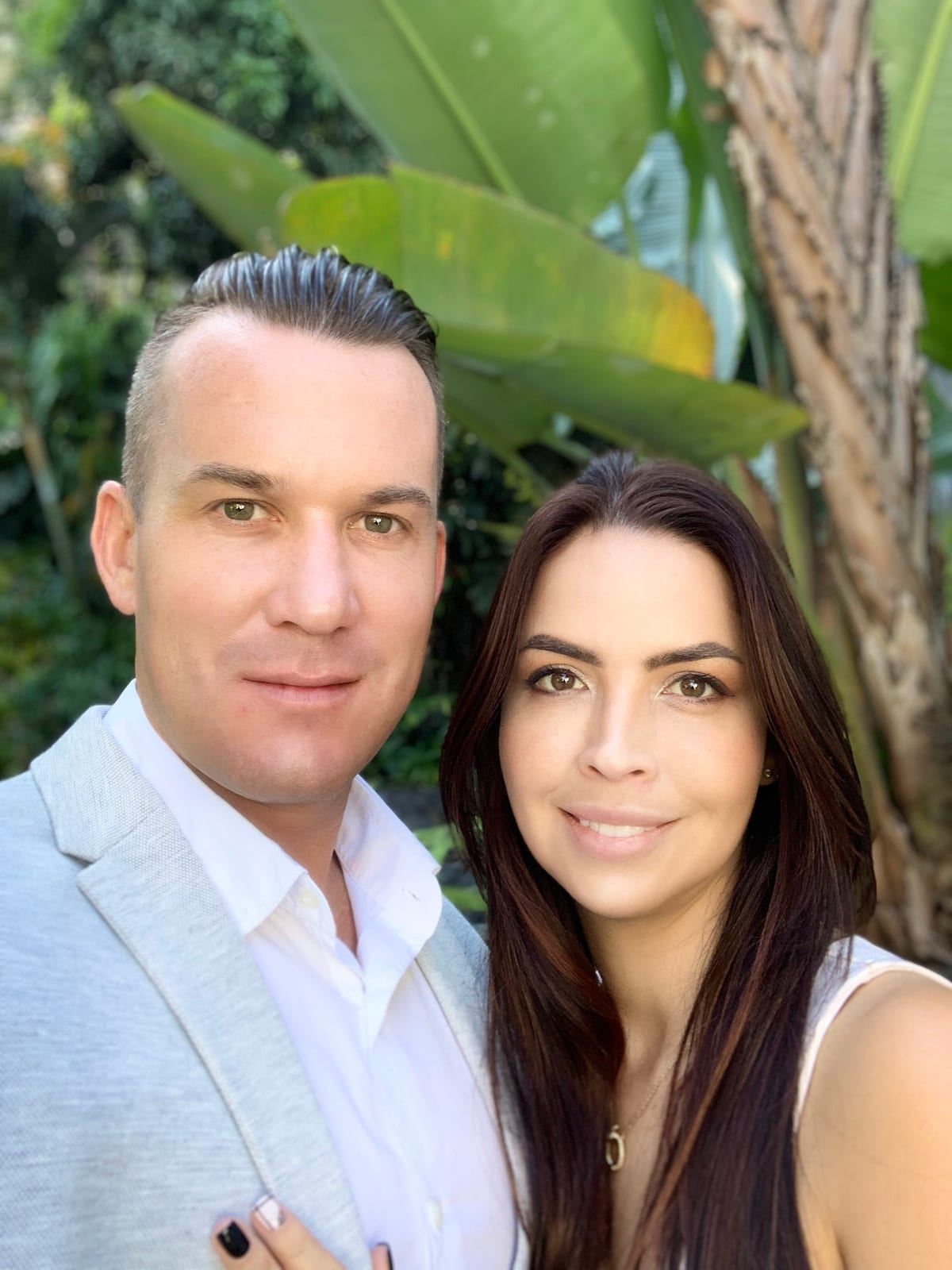
My wife 
The two of us. She was right. - The turnKurt, Paul, Roy
She was right. And the worse part was that the work wasn't even landing. I was getting paid, the adoption numbers looked fine, and the impact wasn't real. Around then a client CEO got fired and I sat with all of it at once. I stopped doing transformation theater.
I took it to Kurt Friedmann and asked how you get people who don't care about winning to want to win. Talking it through with him is where I stopped asking that question and started asking a better one. Not how to make somebody want to win, but why they had stopped climbing at all.
Kurt introduced me to Dr. Paul Stoltz, founder of PEAK Learning, and I began learning from his work on adversity and adaptability. That is where a twenty-year business challenge turned into a question about behavior, with real science under it.
Roy called not long after. Lisette and I were driving north for a weekend it had taken a month to set up. He had moved into a new role a few weeks earlier, he had a four-year upskilling plan in front of him from one of the top three strategy firms, and he needed the content built. I had every piece of it already, built and paid for years ago. I could have closed it from the car.
Instead I told him I could do it, but I didn't really want to. Then I asked whether he thought pushing information at these people was going to change their behavior. He said he didn't think so either. That was the whole exchange, about four seconds, and it came out before I had decided to say it, which is usually how the true things get out.
I didn't tell Lisette any of it in the car. She asked who it was, and I said a chemicals company in Germany. She asked if it was good news. I said yes, which was true and not the whole thing.
- The fieldRoy, LANXESS
Agreeing with me on a phone call cost Roy nothing. What he did next is the real story. One month into a new job he went to his boss, the person who had almost certainly bought the plan, and said he was not going to run it. His boss asked the reasonable question. What are you proposing instead?
Roy said: let me build something and show it to you. Give me enough rope to hang myself. If it does not work it is on me, not on you, and you can tell the CEO it was my idea.
So we had a shot at designing something different. That was thrilling for about a day, and then it became the difficult part, because neither of us knew what different looked like.
What we landed on was the opposite of the plan. Instead of teaching people and hoping it turned up later in the work, we put the work first — teams of three to five who chose each other across business units, taking a real growth challenge and running it for ninety days. The charter went up on a sheet of paper on the wall. At the end they presented it to a panel, and we called that part the science fair.
The coaches were operators. People who had run business units and led chemicals companies, asking questions every week instead of handing over answers. I kept myself out of that role on purpose. The credibility that matters there comes from having done the job, and I had not done theirs.
What made it travel was a deal Roy made with each business unit leader. You choose what you work on, instead of taking one program applied identically everywhere. In exchange, when another unit builds something that works, you stay open to picking it up. Every one of them took the deal.
Their own coaches came in gradually, learning alongside ours first, and by the later cohorts they were coaching Growth Projects themselves with our team behind them. The measures moved the right way. It's one company and a small sample, so I treat that as a direction, not proof. What stayed with me is the thing a measure wouldn't catch. We stopped pushing the program at business units, and business units started asking when it was coming to them. It changed what I thought was possible.
- The ConsortiumWhy I built it
People kept telling me it looked easy when I did it, and I got tired of hearing that. I also kept meeting heads of commercial excellence, strategy and transformation who had no one to compare notes with — no one, at least, who wasn't also trying to sell them something.
So I built a place for them. Invite-only, practitioners only, no vendors. What I get out of it is the one thing I couldn't buy: the people who own these mandates telling me, month after month, what works and what doesn't. Plenty of them are further along than I am on the parts I care most about. That is the point of it.
The Consortium came out of the breakthrough, and the breakthrough was this. It is not about managing change. It is about engineering the conditions for adaptation to happen naturally, without triggering resistance, at the scale of a large company.
The Commercial Excellence Consortium - NowMedellín
I live here with my wife and our two daughters. I'm in the contribution part of my life, and I know how that sounds, but it is the most accurate way I can put it.
The book takes most of my time. I speak where someone has to get a large group of people to work differently. I coach a small number of leaders one to one, where it matters enough and I have something useful to offer. And I keep chasing the question.
Twenty years in, I am less certain of the answer than I was at the start. That is the part I did not expect, and it is most of why I am still doing this.

Things I've built
What I've built since 2006.
2006
Demand Metric
A DIY consulting library of research, playbooks and tools, so commercial leaders could do their own thinking.
It reached 6,589 companies in 108 countries, and it showed that information was usually not the constraint.
Demand Metric2026
Commercial Excellence Consortium™
An invite-only group of 350+ senior leaders who run commercial excellence, strategy and transformation. No vendors.
Built to learn from the people doing the job, not to sell to them.
Visit the Consortiumin progress
TransformationOS™
The operating system behind the work, written down so a company's own team can run it without outside help.
It keeps changing as the field work teaches something new.
See TransformationOSsecond draft
The Transformation Architect
A book about the leaders who make change stick, and what they do differently.
The leaders doing this job are the story.
About the book